Having recently
ventured back into the tournament scene after mostly playing amongst ourselves
for the year so far, as a group we have noticed a few “quirks” in the way the
wargames in general are played. Thus, we offer the following observations on
gaming etiquette, particularly at tournaments where you are often playing
unfamiliar opponents:
It's "grumpy old(ish) men" time! We're not nearly as grumpy as this post sounds. It's just sometimes a good old rant is more entertaining to read and write :-)
1. Dice rolling, specifically the physical act of
dice rolling. Massive kinetic energy does not enhance your odds of getting the
required number! Much time can be wasted retrieving dice from the far end of
the room. There is no +1 bonus for added height on your dice roll/throw/launch.
If you throw dice into terrain that frequently results in cocked dice,
continuing to throw dice into the same terrain will continue to result in
cocked dice. A die is cocked if another die will not sit on top of it, with out falling off. Do not
throw dice into piles of other dice, its then difficult to see which dice you threw and what the resulting number was, as the dice all bounce about from the impact. Just shake up the required number of dice
in your hands, and then drop or gently roll them onto a flat, open area of the
table. Easy.
If you really just can't keep the dice under control, then for everyone's safety maybe you need these? Knitted dice! Perfect for winter.
2. Dice rolling, specifically the declaring of. Do
not start rolling dice without declaring what you are rolling for, what number
you need, and how you arrived at that required number if need be, eg: “rolling
to unpin my artillery, needing a four” or “three main gun shots at your
Panthers, they’re Veterans so that’s 4’s, long range 5”. Remember that you need
to declare the targets for all shooting teams in a platoon before any dice are rolled.
If you just start rolling dice in front of yourself, scooping them up and
claiming success without your opponent having any idea what you are doing, do
not be surprised if you are asked what you are doing. Full disclosure at all
times is a good rule. Likewise, pay attention when your opponent is declaring.
Don’t claim you didn’t know what was happening if you weren’t focused on the
game.
3. Declare your force at the start of the game.
This entails a quick run down of what is in your force, any special rules or
characters you may have, any proxy models you are using and anything else your
opponent may need to know. This doesn't need to be your life story, just a
heads up on any relevant points. Having done this does not relieve you of all
obligations to be sporting on these points during the game. Don’t expect your
opponent to gain an instant knowledge of the ins and outs of your force. Answer
their questions, correct any mistakes, eg:
if you have mixed skill levels in your force, point out if your opponent is shooting
at Trained troops as though they were Veterans (i.e. he thinks he needs a 4 when all he actually needs is a 3, not correcting this, is poor sportsmanship indeed). Declaring dice rolling (and
listening to your opponents) helps to avoid errors like this impacting a game.
When deploying, and throughout the game, be clear about where platoons start
and end. Remember too, it is your responsibility to know when your platoons
need to take morale checks and to take them at the required time, it is not up
to your opponent to request that you take them.
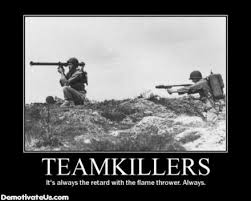
Never a truer word! So don't try and hide them or use confusing proxies please.
4. Declare intentions. This means be clear about
what you are doing. If you are fully inside a wooded area, state that you are
moving to be fully inside the area. Most of the time you will be able to show
this with no problems, but it will save you being caught out if a base gets
bumped later and a corner is poking out of the wood. It also reduces the need for
tedious micro measuring where you have ample movement ability to execute what
you want to do. Declare lines of sight and concealment, eg: if you move a tank
forward behind some cover, state whether you can see an enemy team or not. You
may assume there isn’t a line of sight to a particular target, so you don’t
shoot at it. It’s not good to find out in your opponents turn that you can
suddenly see each other. You may have shot, or not moved there at all.
5. Discuss terrain at the start of the game. Make
it fair. A good general guideline is “keep it simple”. Terrain should obviously
have an impact on the game, but you should be fighting the enemy first and
foremost, not the terrain. Be really clear about what constitutes area terrain,
concealment etc and then stick to it. Different groups play these things
different ways, so long you are both playing the same interpretations it often doesn’t really matter.
6. Rules disputes – play the ball, not the man. For
anyone unfamiliar with the sporting metaphor, take this to mean stick to the
issue in question. If you can’t resolve a rule issue quickly and to mutual
satisfaction, look it up in the rule book. Don’t try and force your view on
your opponent without backing it up. Nobody likes a bully. Don’t try and brow
beat someone into your point of view, and then back off saying “ok, we’ll play
it your way because I’m such a nice guy” when you realise you don’t have a leg
to stand on. If you’re wrong, admit it. Stick to the issue, reach for the rule
book. If in doubt, dice for it and move on. Simmering tensions will quickly
lead to more issues if anyone feels they are “owed a break”. Similarly, don’t
question someone’s integrity or call them a cheat without being able to back it
up. You may know they cheated, but you won’t achieve anything positive without
being able to prove it. Conversely, just because you forgot something or didn’t
ask about something you were unsure of, or had a genuine miscommunication, does
not make the other player a cheat. An error on your part does not constitute
cheating. Deliberate, contrived cheating is extremely rare, and most issues can
be sorted in a gentlemanly fashion, so don’t be too quick to start name
calling. There would be few sadder sights than grown men having fisticuffs over
a game of toy soldiers! Plus, you never know who’s secretly a ninja-trained
killing machine when they’re not painting little tanks…

Don't be this guy.
7. Some real basics, but you’d be surprised (or
not) at some of the things we’ve seen. “Elastic tape measures” are one of these
things. Also measuring movement, then taking away the tape measure and moving
the model past the allowable distance. If you’ve forgotten to do something in a
particular step and moved on to the next step, either suck it up and remember
next time, or ask your opponent if they mind you acting out of sequence. Do not
just start moving models around after shooting, or deploy a “forgotten” platoon
half way through the game without asking first. 99% of the time it will be OK,
and you should always try and correct these errors in a way that doesn’t
adversely impact your opponent. After all, it was your mistake. I once had an
opponent start making some “forgotten” movement in my turn, after I’d moved
some of my platoons! He didn’t even ask, just did it brazenly. I was not
impressed.
8. Take it like a man! Don’t deliberately play slow
for a time out win. If a game times out and robs you of victory but your
opponent was playing at a good pace then don’t take it out on them. Likewise,
don’t blame your opponent for slow play if you spent half the game wandering
off around the room. If it’s not going your way, don’t sulk. Always try and
play as positively as possible. You’ll have more fun and gain more respect, and
probably get better results too.
Whew! Quite a rant
indeed! Please note that these observations are gained from years of our own
experience, the experiences of others, and just general pet peeves. They are
not aimed at anyone in particular, but hopefully set a standard for all of us.
In my own experience, the vast majority of gamers play to enjoy the game and
that will always shine through. At times things can get tense, but
communication is the key. It’s all war stories in the end.
Cheers,
Paul and Scott.


